




“An investment in clean energy only pays back when the panels are actually clean.” — Solar Industry Review, 2026
Pakistan crossed 45 gigawatts of installed solar capacity in 2025, making it one of the fastest-growing solar markets in the world. Yet most homeowners do not realise that dirty panels can silently drain 15 to 30 per cent of their system’s output every single month. A professional solar panel washing service is not routine maintenance. It is the difference between a solar investment that performs and one that quietly underdelivers.
In 2026, with electricity tariffs at record highs and net billing replacing net metering, every lost unit costs more than it ever has before. Solcare provides dedicated solar panel washing service solutions built specifically for Pakistan’s dust-heavy climate, ensuring your system produces what it was designed to produce all year round.
Why Solar Panels Get Dirty Faster in Pakistan
Pakistan’s climate creates some of the most challenging conditions for solar panel surfaces in the world. Unlike regions where rainfall provides natural cleaning, most Pakistani cities experience long dry seasons where dust accumulates on panels without interruption.
The most common contaminants affecting output in 2026 include:
- Fine desert dust and smog particles that form a thin efficiency-blocking film
- Bird droppings that create hot spots and cause permanent cell damage if left unaddressed
- Industrial pollution residue in cities like Karachi, Lahore, and Faisalabad
- Hard water deposits from previous rain or DIY cleaning with unfiltered tap water
- Pollen and organic debris near trees or agricultural areas
Each of these deposits blocks incoming sunlight differently. Dust causes a gradual, uniform loss, while bird droppings and hard water deposits create concentrated shading that can damage individual cells permanently over time.
What Happens When Panels Are Not Cleaned Regularly
The financial impact of dirty panels is direct and measurable. Research from NREL and university studies consistently shows that soiled panels produce 15 to 25 per cent less energy than clean ones. In Pakistan’s dust-heavy environment, that figure can reach 30 per cent during peak summer months.
The table below shows how efficiency loss translates into real monthly unit loss for common system sizes:
| System Size | Clean Output (Monthly) | 20% Loss | 30% Loss | Monthly Units Lost |
| 3 kW | 450 units | 360 units | 315 units | 90 to 135 units |
| 5 kW | 750 units | 600 units | 525 units | 150 to 225 units |
| 10 kW | 1500 units | 1200 units | 1050 units | 300 to 450 units |
At current tariff rates of Rs 22 to Rs 44 per unit, a 10 kW system owner losing 30 per cent output could be losing between Rs 6,600 and Rs 19,800 every single month simply because their panels have not been washed.
What a Professional Solar Washing Service Actually Includes
A proper solar panel washing service is not just spraying water on glass. Solcare’s professional service follows a structured process designed to protect the panel surface while restoring maximum light absorption.
Step 1: Pre-Wash System Check
Before any water touches the panels, the technician conducts a visual assessment of the system, checking for physical damage, loose connections, and debris around the mounting structure.
Step 2: Deionised Water Cleaning
All washing is carried out using deionised or purified water. Tap water in Pakistan contains high mineral content that leaves deposits on panels after evaporation, reducing efficiency further than the dirt being removed. Deionised water evaporates completely clean, leaving no residue behind.
Step 3: Soft Brush Application
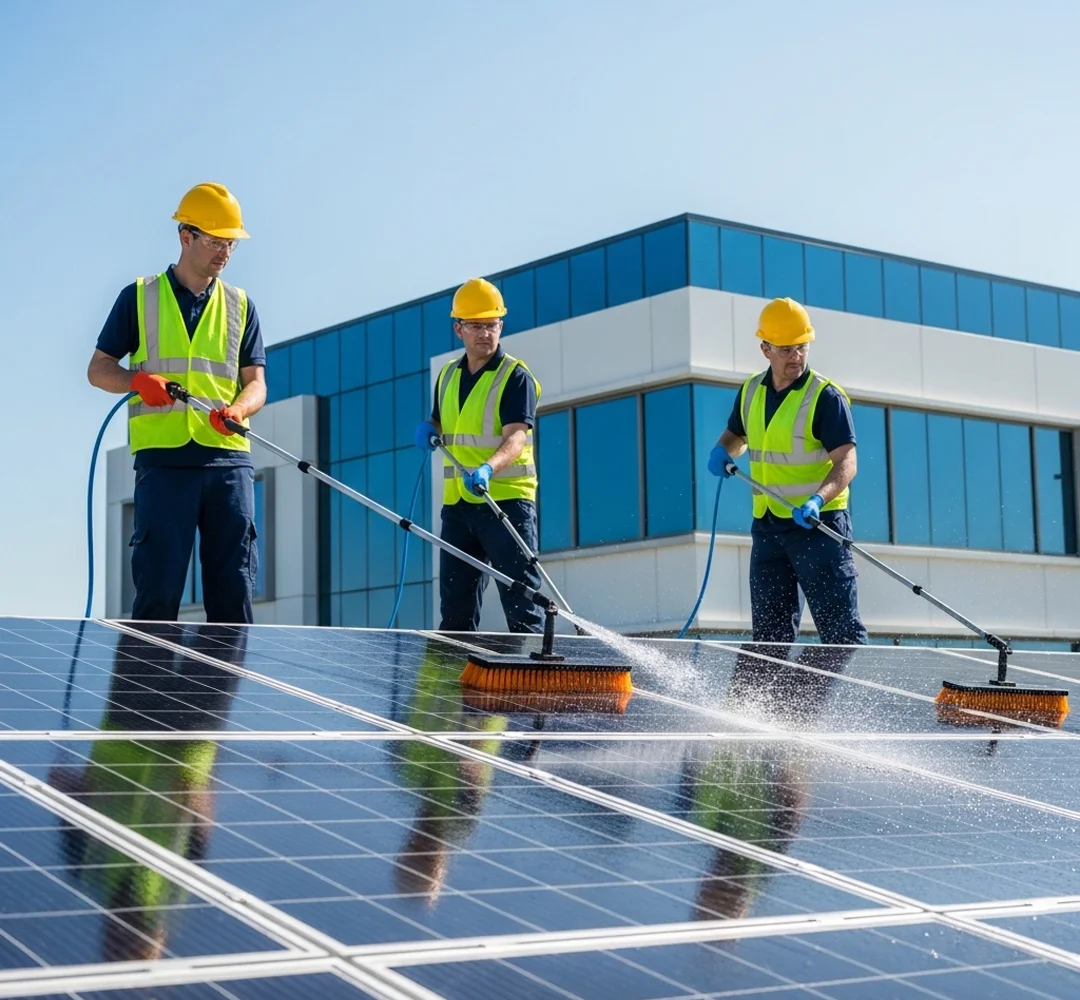
Using a solar panel cleaning brush with a motor fed through a water-pole system, technicians clean panel surfaces from a safe working position without applying pressure that could cause micro-cracks in the glass or damage anti-reflective coatings.
Step 4: Post-Wash Rinse and Inspection
A final rinse removes any loosened particles, and the technician performs a post-clean inspection to confirm the surface is clear and undamaged.
Solar Panel Cleaning Methods Compared
Not all cleaning approaches deliver the same result or protect your panels equally. The table below compares the main methods available in Pakistan in 2026:
| Method | Safety | Effectiveness | Risk of Damage | Recommended |
| Deionised water with a soft brush | High | Excellent | Very Low | Yes |
| Tap water with a cloth | Medium | Poor | Medium | No |
| Pressure washer | Low | Good | Very High | Never |
| Dry brush only | Medium | Low | Medium | No |
| Automated robotic cleaner | High | Good | Low | Situational |
Pressure washing is the most common DIY mistake. High pressure can crack panel glass, break cell seals, and void manufacturer warranties. For more on safe cleaning approaches, read the ultimate guide to solar panel cleaning.
How Often Should You Book a Washing Service
Cleaning frequency depends on your location, system tilt angle, and surrounding environment. The general recommendation for Pakistan in 2026 is:
- Karachi and coastal areas: Every 6 to 8 weeks due to dust and salt air deposits
- Lahore and central Punjab: Every 6 to 10 weeks during the dry season, less frequently after the monsoon
- Islamabad and northern regions: Every 8 to 12 weeks, adjusted for seasonal tree pollen
- Industrial or construction zones: Every 4 to 6 weeks, regardless of the city
Flat-mounted panels accumulate dirt significantly faster than tilted systems because rainwater cannot assist with partial self-cleaning. If your panels are mounted at less than 15 degrees, more frequent service is strongly recommended.
System Inspection and What It Covers
A professional wash visit from Solcare includes a system inspection at no additional cost. This covers more than most homeowners expect and often catches issues before they become expensive repairs.
The inspection checks for:
- Hot spots caused by shading, soiling, or cell damage that reduce output from specific panels
- Micro-cracks in panel glass resulting from thermal stress, impact, or previous improper cleaning
- Wiring and junction box condition, including any signs of rodent damage, UV degradation, or moisture ingress
- Mounting structure integrity, including bracket corrosion, loose bolts, and frame alignment
- Inverter indicator review to flag any error codes or performance anomalies visible during the visit
Early detection through regular inspection consistently prevents the kind of faults that shut down entire systems and require costly emergency repairs.
Solar Maintenance and Carbon Credits
Regular solar maintenance service does more than protect your investment. It directly affects how much clean energy your system produces over its lifetime and, by extension, how many emissions it avoids generating from the grid.
A 5 kW system operating at full efficiency avoids approximately 6.5 tons of carbon dioxide annually. The same system running at 75 per cent efficiency due to dirty panels avoids only 4.9 tons, a gap of 1.6 tons every year, which represents both lost environmental contribution and lost potential carbon credits.
Pakistan is developing policy frameworks for voluntary carbon market participation following COP-29 commitments. Solar system owners who can demonstrate consistent, verified energy production through regular professional maintenance are building the performance record that will support carbon credits eligibility as Pakistan’s carbon market infrastructure matures in 2026 and beyond.
Why DIY Cleaning Causes More Harm Than Good
Many homeowners attempt to clean their own panels to save money. In practice, DIY cleaning frequently reduces savings rather than protecting them.
The most common DIY mistakes and their consequences:
- Using tap water leaves mineral deposits that bond to anti-reflective coatings and reduce transparency over time
- Using a pressure washer risks micro-cracks, seal damage, and immediate warranty voidance
- Using household detergent leaves a sticky residue film that attracts more dust and accelerates soiling
- Walking on or leaning against panels causes physical stress, and cracks not visible to the naked eye
- Cleaning during peak sun hours causes rapid temperature-change stress on the glass surface
Beyond equipment risk, rooftop work without professional safety equipment is one of the leading causes of household accidents in Pakistan. A professional solar panel washing service eliminates all of these risks while delivering a result that genuinely restores output.
Conclusion
A dirty solar system is a losing investment. Whether you have a 3 kW rooftop setup or a large commercial array, the output gap between a clean and an unclean system translates directly into money lost every single month.
Solcare’s professional solar panel washing service restores your system to its designed performance, protects your warranty, extends panel lifespan, and keeps your energy savings working the way they should. From deionised water cleaning and soft-brush technology to full system inspection and solar maintenance service, every visit is built around protecting what you have invested.
Read the ultimate guide to solar panel cleaning to go deeper, or contact Solcare today and book your first professional wash. Your panels have been working hard. It is time to give them the care that keeps them working for you.
FAQs
How often should I book a professional solar panel washing service?
Most Pakistani homes need a solar panel washing service every 6 to 10 weeks, depending on location, dust levels, and panel tilt. Coastal and industrial areas need more frequent cleaning.
Do dirty panels really affect my electricity bill?
Yes. Soiled panels lose 15 to 30 per cent of output. At current tariff rates that means hundreds to thousands of rupees in lost savings every month, depending on system size.
What is included in Solcare’s system inspection?
The system inspection covers hot spot detection, wiring checks, mounting integrity, micro-crack assessment, and inverter error review. It is included with every professional wash visit.
Can regular cleaning help with carbon credits?
Yes. A system operating at full efficiency avoids more emissions, building a stronger verified performance record for future carbon credits eligibility as Pakistan’s carbon market develops.
Is the solar panel cleaning brush with motor safe for all panels?
Yes. The solar panel cleaning brush with motor used by Solcare is a soft-bristle, water-fed system that meets manufacturer safety standards and does not damage anti-reflective coatings or glass surfaces.

